
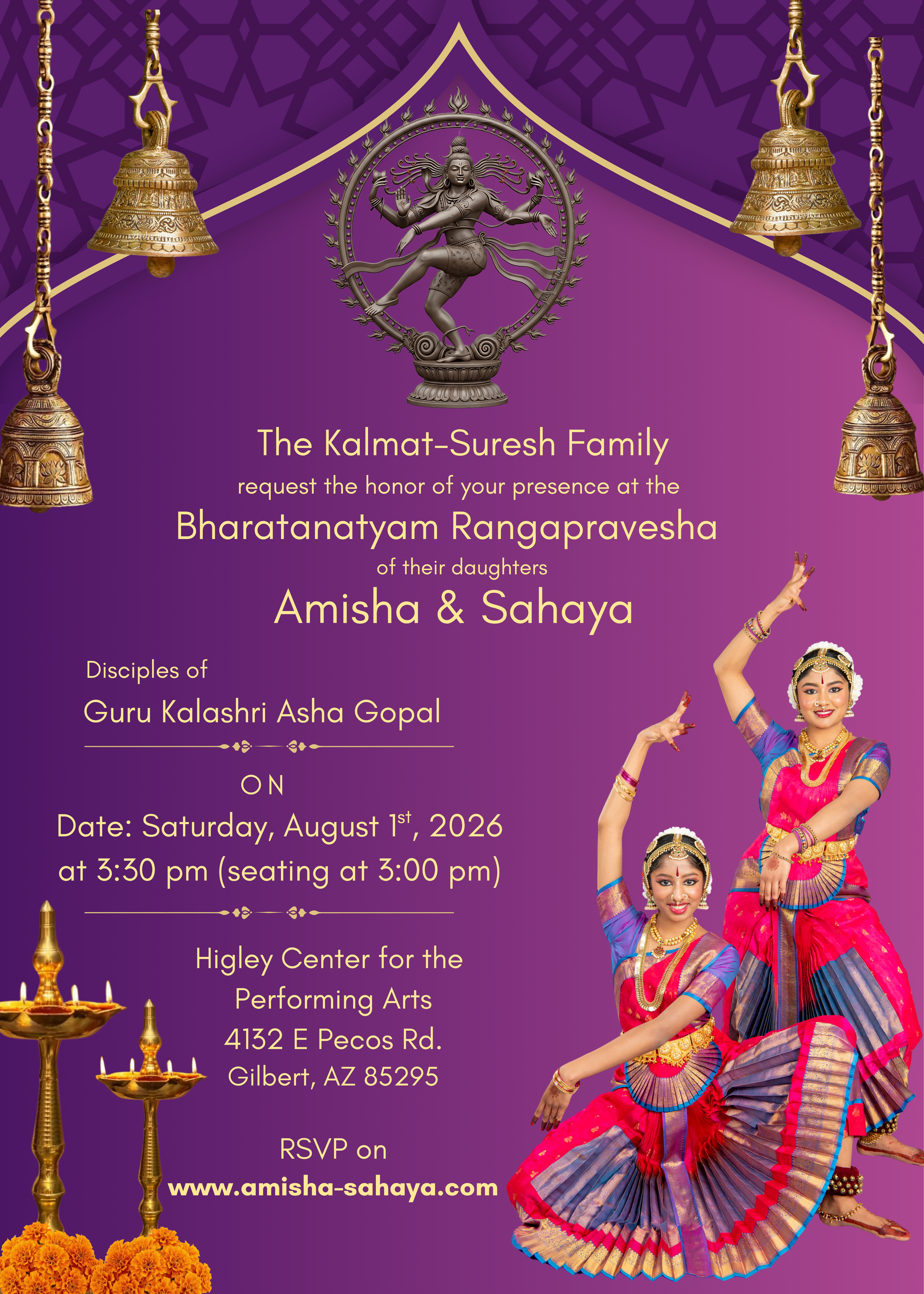
Date: August 1st, 2026
Time: 3:30 pm (seating starts at 3:00 pm)
Please consider a donation to Arogya for Kids rather than a personal gift.
QR codes will be available at the event for donations.
Thank you
Bharatanatyam
Bharatanatyam is one of the oldest and most classical dance forms of India, originating in the temples of Tamil Nadu. It’s a highly expressive art form that combines dance (nritta), storytelling (nritya), and drama (natya). At its core, Bharatanatyam is about telling stories through the body. Dancers use a precise language of:
Mudras-Hand gestures to represent objects, ideas, or emotions
Abhinaya-Facial expressions to convey feelings and narratives
Footwork and rhythmic patterns that are synchronized with music
The dance is usually performed to Carnatic music, and themes often come from Hindu mythology, devotion, and spiritual ideas—though modern performances can explore a wide range of topics.
Bharatanatyam Rangapravesha
A Bharatanatyam Rangapravesha (also called Arangetram) is the formal debut solo performance of a Bharatanatyam student . The moment they step onto the public stage for the first time as a complete dancer.
The word breaks down meaningfully: ranga means stage, and pravesha means entry or debut. It literally marks the dancer's "entry onto the stage."
The significance
The performance typically lasts 2.5 to 3+ hours. It is a deeply emotional occasion for the student, the guru, and the family — involving years of preparation, significant expense, and community gathering. The guru's blessing is central; without it, the student cannot perform. In many families, especially those with roots in South Indian classical traditions, it carries the weight of a coming-of-age ceremony.
After the Rangapravesha, the dancer is considered to have "graduated" from foundational training and may begin teaching, performing independently, or pursuing advanced repertoire.